William Gibson’s short fiction presents an interesting structural duality. His solo-authored stories tend toward stream-of-consciousness, beatnik-inflected prose that prioritizes internal states over plot mechanics. His collaborative work—particularly with Bruce Sterling (“Red Star, Winter Orbit”), John Shirley (“The Belonging Kind”), and Michael Swanwick (“Dogfight”)—exhibits a notably different architecture.
La Struttura della Collaborazione
The co-authored pieces share certain characteristics that distinguish them from Gibson’s solo efforts. They maintain clearer narrative throughlines, reduce digressive internal monologue, and privilege plot progression over atmospheric immersion. “Red Star, Winter Orbit,” for instance, operates as a tightly constructed space drama with clear dramatic beats—decommissioned Soviet space station, geopolitical context, character conflict resolution. The prose serves the narrative engine rather than creating ambient texture.
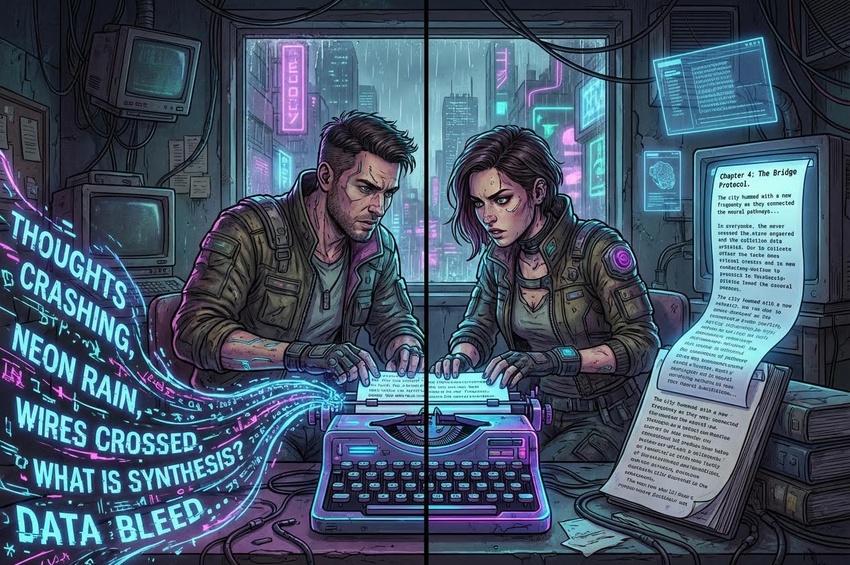
This isn’t necessarily a value judgment about which approach works better. It’s an observation about how collaborative authorship appears to function as a structural constraint. When Gibson writes alone, the text can follow associative logic, linguistic play, and phenomenological exploration. When writing with a collaborator, the narrative requires negotiation—a shared understanding of what happens next, which inherently privileges plot clarity.
Il Caso Sterling: “Red Star, Winter Orbit”
Sterling’s influence on this particular story seems substantial. The piece reads like classic hard SF with Gibson’s sensibility layered on top—Soviet space program realpolitik, Cold War tension, the melancholy of abandoned technological dreams. The line “This cosmograd was a dream, Colonel. A dream that failed like space” functions as both character dialogue and thematic statement, delivered with efficiency rather than circling it through consciousness.
Gibson’s solo work might have spent paragraphs inside the Colonel’s head, fragmenting the realization across sensory impressions and memory. Here, the collaborative structure demands the theme be articulated, moved past, allowing the plot to continue. The story benefits from this compression—it gains dramatic momentum at the cost of some of Gibson’s characteristic immersive texture.
Shirley e Swanwick: Chiarezza vs. Atmosfera
“The Belonging Kind” (with Shirley) and “Dogfight” (with Swanwick) follow similar patterns. Both stories maintain focus on their central conceits—mimetic beings and AR dogfighting competitions, respectively—without the narrative drift that characterizes pieces like “Fragments of a Hologram Rose.” The collaborative process seems to function as an editorial filter, requiring each narrative element to justify its presence in service of the story’s forward motion.
This raises questions about Gibson’s creative process. Does he naturally write in a more associative mode, which collaborators then help structure? Or does the collaborative contract itself—the implicit agreement to produce something mutually comprehensible—shift his approach from the outset? The consistency of the pattern across multiple collaborators suggests the latter: that writing with another author activates a different narrative mode, one that privileges shared understanding over individual vision.
Il Paradosso della Leggibilità
There’s an interesting tension here. Gibson’s solo work is often described as more difficult, more “literary,” requiring more from the reader. The collaborative pieces are more accessible, more conventionally structured. Yet accessibility doesn’t necessarily correlate with impact. “Johnny Mnemonic” (solo) has had massive cultural influence despite—or perhaps because of—its stream-of-consciousness sections. The collaborative stories, while more readable, don’t seem to have penetrated the cultural imagination with the same force.
This might suggest that Gibson’s authentic voice—the one that requires no mediation or structural negotiation—is precisely the one that makes his work distinctive, even when it makes individual stories harder to parse. The collaborations smooth out the roughness, but the roughness might be where the original thinking lives. When two authors must agree on what happens next, certain kinds of narrative experimentation become difficult to sustain. You can’t both hold the wheel and let it drift.
How much of Gibson’s influence on cyberpunk stems specifically from his willingness to let narrative drift, to prioritize phenomenology over plot? The collaborative stories suggest that when forced to choose, he can write conventional structure perfectly well. Which makes his choice not to, in his solo work, more deliberate than it might initially appear.